Blog · 2025-02-03
A Brief History of Paraguay: Part 3
Relations with Argentina and Brazil
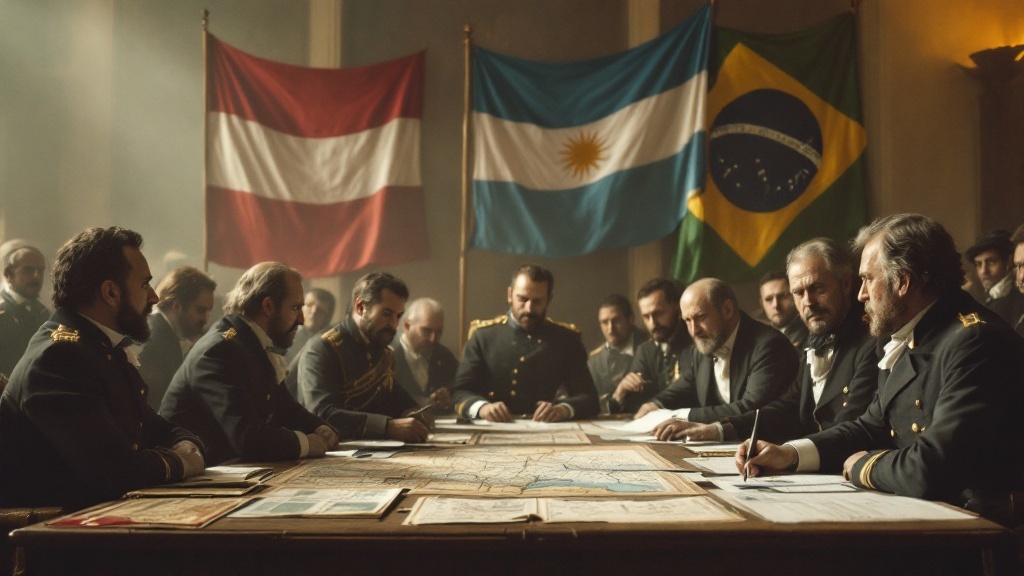
After Perón's overthrow in 1955, Argentine influence in Paraguay waned. Economic and political instability in Argentina pushed Paraguay to reorient itself toward cooperation with Brazil, which became its key partner - a shift that alarmed Buenos Aires. Argentina tried to reclaim its influence by offering Paraguay a role in building the Yacyretá and Corpus hydroelectric dams. Stroessner managed to play Brazil and Argentina off against each other, strengthening Paraguay's economic and diplomatic autonomy.
Relations with the United States and Taiwan
During the Cold War, the United States backed anti-communist regimes. In 1957 Paraguay established diplomatic relations with Taiwan, reinforcing its ties to the bloc of nations aligned against China and the USSR. In 1958 US Vice President Richard Nixon visited Asunción, where he praised Paraguay for its commitment to fighting communism.
Washington actively supported the Stroessner regime as one of its most reliable allies in Latin America. Its main strategic goal was to prevent a leftist regime from taking power in Paraguay, which could have become a haven for revolutionaries and radical movements across the region. Between 1947 and 1977 the United States supplied Paraguay with roughly $750,000 in military equipment each year and trained more than 2,000 Paraguayan officers in counter-intelligence and counter-insurgency.
Paraguay consistently voted with the United States at the UN and the Organization of American States (OAS). Stroessner called the US ambassador "an extra member of his cabinet," underscoring his loyalty to Washington.
Under President John F. Kennedy (1961-1963), however, relations deteriorated:
- The United States began demanding democratic and agrarian reforms in Paraguay.
- Washington threatened to cut off funding provided through the Alliance for Progress, which accounted for around 40% of the country's budget.
- This forced Stroessner to legalize some opposition parties, though he never relinquished his dictatorial power.
Under Lyndon Johnson (1963-1969), the United States again warmed to Stroessner, especially after Paraguay backed the US military intervention in the Dominican Republic in 1965.
The break with the United States in the 1970s
In 1976 Jimmy Carter became US president, placing human rights at the center of his agenda. In 1977 the US Congress halted military shipments to Paraguay. The new American ambassador, Robert White (1977), sharply criticized human rights abuses there. In 1980 the Inter-American Court of Human Rights found Paraguay guilty in the torture case brought against Peña-Irala.
Corruption and illicit trade
The Stroessner regime was deeply corrupt and rested on a "triad of power": the state, the Colorado Party and the armed forces. Smuggling became a key source of revenue for the regime, thanks to Paraguay's position between Brazil, Argentina and Bolivia. Alcohol, drugs, cars and exotic animals were trafficked into the country illegally. By some estimates, the volume of contraband was three times the official export figures. Stroessner used part of this money to buy the loyalty of the military and officials, rewarding them with cash, land and infrastructure projects.
Concentration of wealth and the land question
Economic inequality in Paraguay became among the highest in the world. According to Oxfam, 1.6% of the population owned 80% of the land. Between 1954 and 1989, roughly 8 million hectares were illegally transferred to friends of the regime - a third of all farmland. Oxfam and Amnesty International both condemned the Stroessner regime for its land concentration and corruption.
Operation Condor and human rights abuses in Paraguay
Paraguay took part in Operation Condor, the international campaign of repression against political opponents organized by South America's military dictatorships in the 1970s and 1980s. The "Archives of Terror" - documents confirming Paraguay's role in the operation - were discovered in 1992 at a police station in Lambaré, near Asunción. The United States supported the Stroessner regime and even helped establish the "La Técnica" torture center; US Army Lieutenant Colonel Robert Thierry helped build the interrogation facility. "La Técnica" became one of the most notorious torture centers, and one of the regime's cruellest torturers was Pastor Coronel.
The overthrow of Stroessner (1989)
By the 1980s Paraguay had become less isolated, but its political and social structure remained unchanged. The elections of 1983 and 1988 were rigged, with Stroessner taking almost 90% of the vote while maintaining the veneer of a multiparty system.
The coup of 3 February 1989. Stroessner was overthrown by General Andrés Rodríguez. The dictator fled to Brazil, where he died in 2006 - with numerous human rights cases pending against him at the time of his death.
The aftermath of the coup
Using Stroessner's own constitution, Rodríguez organized elections in May 1989. He won with the backing of the Colorado Party, which retained control of Congress. After the dictatorship fell, thousands of Paraguayans began occupying unused land that had previously belonged to the state, the Stroessner family, his associates and foreign investors. By 1990 some 19,000 families had occupied more than 360,000 hectares, mainly in the eastern and northern border departments and other rural areas. At the time, of Paraguay's 4.1 million people, 2.06 million lived in the countryside.
In the 1991 municipal elections the opposition won in major cities, including Asunción. As president, Rodríguez launched political, legal and economic reforms and restored Paraguay's international ties.
Paraguay's 1992 Constitution
The Republic of Paraguay is governed by the Constitution adopted on 20 June 1992. It is the fifth constitution since independence in 1811 - and the first genuinely democratic one.
Earlier laws and constitutions
The Governing Regulations of 1813
Adopted by Congress in October 1813, they contained 17 articles that:
- created a system of government led by two consuls (José Gaspar Rodríguez de Francia and Fulgencio Yegros);
- established a legislative assembly of 1,000 representatives;
- granted each consul the rank of brigadier general and divided the army and arsenals between them.
Ten years later, Francia eliminated Yegros and the legislature, ruling alone until his death in 1840.
The State Administration Law of 1844
In 1841 Consul Carlos Antonio López called for a revision of the laws. In 1844 a new system of government was adopted:
- Congress was made up of the elite (lawyers, landowners, patricians);
- Congress could draft and interpret laws, but only the president could approve and enforce them;
- there were no guarantees of civil rights (the word "freedom" did not even appear in the text);
- the presidential term was capped at 10 years, though López was later elected for life.
In 1856 the Constitution was amended, removing the requirements for the presidency (civilian status, a minimum age of 45, marriage) - clearing the way for Francisco Solano López to take power after his father's death.
The 1870 Constitution
The first liberal constitution, inspired by those of the United States, Argentina and other Western countries:
- it enshrined a broad set of rights and guarantees;
- it allowed the passage of agrarian laws, including the "Law on Colonization and Property," the creation of a Department of Labor and the operation of the Agricultural Bank of Paraguay.
Executive branch. The President of the Republic had to be:
- a Paraguayan citizen by birth;
- a Christian;
- at least 30 years old.
The president was chosen by indirect vote for a four-year term and could not be re-elected until two full terms had elapsed after leaving office. He appointed and dismissed ministers at his discretion, while the vice president simultaneously presided over the Senate.
Judicial branch. The Supreme Court consisted of three members appointed by the president with the Senate's approval, alongside lower courts and tribunals. The 1870 Constitution remained in force for roughly 75 years and helped move Paraguay gradually toward democracy.
The 1940 Constitution
Adopted in July 1940 by President José Félix Estigarribia, who had earlier dissolved Congress and declared himself dictator, it enshrined a strong presidency:
- the president was elected for five years and could be re-elected;
- he could intervene in the economy, control the press, suppress private organizations and restrict civil liberties.
The Senate was abolished and the Chamber of Deputies weakened. A Council of State was created, with representatives from:
- business;
- agriculture;
- the banking sector;
- the army;
- the Catholic Church.
The army was given a constitutional duty to "defend" the Constitution. This charter legalized a corporatist state modeled on Mussolini's Italy and Salazar's Portugal.
The 1967 Constitution
The dictator Alfredo Stroessner (in power since 1954) initiated a revision of the Constitution, adopted by a Constituent Assembly in 1967. Its main changes:
- a strong presidency was preserved;
- the Senate and Chamber of Deputies were restored;
- the president still wielded enormous powers.
The document contained a preamble, 11 chapters, 231 articles and final provisions. Its first section set out the fundamental principles:
- the form of government - a unitary republic with democratic representation;
- the official religion - Catholicism;
- the state languages - Spanish and Guaraní (though only Spanish was considered official).
Subsequent sections dealt with territory, administrative divisions, citizenship and nationality, and the functions of state bodies.
Section V (67 articles) covered citizens' rights. It guaranteed freedom and equality before the law and included 33 articles on individual rights, plus sections on:
- social and economic rights;
- labor rights;
- political rights.
Article 111 established that voting was:
- a right;
- a duty;
- a function of the state.
Forming parties that threatened the republican order or multiparty democracy was prohibited.
Section VIII - Agrarian reform:
- a just land reform was proclaimed;
- a system of fair land distribution was guaranteed;
- the state encouraged colonization not only by citizens but also by foreigners.
Sections IX-X dealt with the legislative, executive and judicial branches and the Attorney General's Office.
Section XI - Amendments to the Constitution. Transitional provisions allowed Stroessner to run for another term in 1968, and a 1977 amendment permitted unlimited re-election.
The geography of Paraguay
Paraguay is landlocked, but two major rivers connect it to the Atlantic Ocean.
The Paraguay River (Río Paraguay)
- Length: 2,800 km, of which 1,023 km flow through Paraguayan territory.
- Average width: 500 m.
- Average depth: 5 m.
- Navigable along most of its course.
The Paraná River (Río Paraná)
Formed by the confluence of the Grande and Paranaíba rivers. Its main tributaries are:
- the Tietê;
- the Paranapanema;
- the Iguazú.
Main tributaries of the Paraguay River (left bank)
The Apa River (Río Apa):
- Length: 480 km.
- Source in the Cordillera del Amambay.
The Aquidabán River (Río Aquidabán):
- Length: 270 km.
The Jejuí Guazú River (Río Jejuí Guazú):
- Length: 350 km.
- Main tributary - the Aguará Guazú River.
The Ypané River (Río Ypané):
- Length: 282 km.
- Source in the Cordillera del Amambay.
The Manduvirá River (Río Manduvirá):
- Length: 212 km.
- Source in the Cordillera de los Altos.
Mountain ranges (cordilleras) of Paraguay
- Cordillera del Ybytyruzú;
- Cordillera de Caazapá;
- Cordillera de los Altos;
- Cordillera de San Luís;
- Cordillera de Ybytypanemá;
- Cordillera del Amambay.
Further tributaries of the Paraguay River
Left-bank tributaries:
- The Piribebuy River (Río Piribebuy) - 102 km.
- The Paray River (Río Paray) - the outflow of Lake Ypoá.
- The Salado River (Río Salado) - 28 km, flowing out of Lake Ypacaraí.
- The Tebicuary River (Río Tebicuary) - 360 km.
Right-bank tributaries:
- The Negro River (Río Negro) - 400 km, mostly in Bolivia.
- The Verde River (Río Verde) - 275 km.
- The Confuso River (Río Confuso) - 290 km.
- A second Negro River (Río Negro) - 50 km.
- The Pilcomayo River (Río Pilcomayo) - 1,590 km (of which 835 km form the natural border between Paraguay and Argentina). Its source is in the Andes of Bolivia, and it joins the Paraguay River opposite Cerro Lambaré. Its flow is irregular, depending on glacial melt.
Paraguay's neighbors
- Bolivia (northwest);
- Brazil (northeast and east);
- Argentina (south and southwest).
Paraguay is the only country in South America without an ocean coastline that nonetheless reaches the Atlantic - through the Paraguay and Paraná rivers.
Paraguay's natural regions
The Paraguay River divides the country into two natural zones: the Eastern Region (Región Oriental) and the Western Region (Región Occidental), known as the Chaco.
The Western Region (Región Occidental / Chaco)
Key features:
- it covers 61% of Paraguay's territory but is sparsely populated;
- it lies on the western bank of the Paraguay River;
- it forms a biogeographic barrier separating the Western Region from the Eastern one;
- its landscape is a vast dry plain with a few scattered hills (such as Cerro León).
Climate:
- semi-arid and warm (in the west of the region);
- tropical savanna (in the south and northwest - the departments of Alto Paraguay and Presidente Hayes);
- dry winters and wet summers;
- temperatures above 30 °C from September to April;
- summers marked by flooding as the rivers overflow.
Natural wealth - forests with unique tree species:
- Palo Santo;
- Quebracho;
- Guatambú;
- Palo Trébol.
Economic activity: cattle ranching is the main pursuit.
The Eastern Region (Región Oriental)
Key features:
- it covers 39% of Paraguay's territory (smaller than the Chaco, yet home to most of the country's population);
- it lies on the left bank of the Paraguay River and stretches eastward.
Climate:
- south - humid subtropical (average annual temperature 20 °C);
- north - tropical savanna (average annual temperature 24 °C);
- hot summers (around 30 °C) with heavy rain;
- mild winters (16 °C in the south, 19 °C in the north);
- abundant rainfall, especially in the south.
Landscape:
- humid, rolling plains;
- numerous rivers and bodies of water;
- mid-altitude mountain ranges: Caaguazú, Mbaracayú and Amambay;
- tropical and subtropical forests.
Economy: rich farmland. Its key products are:
- timber;
- petitgrain essential oil;
- yerba mate (the basis of the traditional Paraguayan drink tereré).
Ecoregions of the Eastern Region:
- Aquidabán;
- Amambay;
- Alto Paraná;
- Selva Central;
- Litoral Central;
- Ñeembucú.
Paraguay's departments and their capitals
- Concepción - capital: Concepción.
- San Pedro - capital: San Pedro.
- Cordillera - capital: Caacupé.
- Guairá - capital: Villarrica.
- Caaguazú - capital: Coronel Oviedo.
- Caazapá - capital: Caazapá.
- Itapúa - capital: Encarnación.
- Misiones - capital: San Juan Bautista.
- Paraguarí - capital: Paraguarí.
- Alto Paraná - capital: Ciudad del Este.
- Central - capital: Areguá.
- Ñeembucú - capital: Pilar.
- Amambay - capital: Pedro Juan Caballero.
- Canindeyú - capital: Salto del Guairá.
- Presidente Hayes - capital: Villa Hayes.
- Boquerón - capital: Filadelfia.
- Alto Paraguay - capital: Fuerte Olimpo.
In all, Paraguay has 17 departments plus the capital, Asunción, which holds autonomous status.
Paraguay's national symbols
Official languages: Spanish and Guaraní.
The symbols of the Republic of Paraguay (under Article 139 of the Constitution) are:
- the Flag of the Republic (Pabellón de la República);
- the National Seal (Sello Nacional);
- the National Anthem (Himno Nacional).
The flag of Paraguay
The flag consists of three horizontal stripes of equal width:
- red (top) - a symbol of justice;
- white (middle) - a symbol of peace;
- blue (bottom) - a symbol of freedom.
It was officially adopted on 25 November 1842 at the Extraordinary General Congress.
A distinctive feature: the Paraguayan flag is unique in that its front and back bear different emblems.
Obverse (front):
- the national coat of arms with a golden star encircled by a wreath of palm and olive branches;
- the inscription "República del Paraguay" (Republic of Paraguay).
Reverse (back):
- a second emblem depicting a lion, a Phrygian cap and the motto "Paz y Justicia" (Peace and Justice).
The national anthem of Paraguay (abridged version)
Title: Himno Nacional Paraguayo.
Text (abridged):
A los pueblos de América infausto
Tres centurias un cetro oprimió
Mas un día, soberbia surgiendo
¡Basta! dijo y el cetro rompió.
Nuestros padres lidiando grandiosos
Ilustraron su gloria marcial.
Y trozada la augusta diadema
Enalzaron el gorro triunfal.
¡Paraguayos, República o muerte!
Nuestro brío nos dio libertad.
Ni opresores, ni siervos alientan
Donde reinan unión e igualdad.
¡Unión e igualdad!
¡Unión e igualdad!
The anthem's central themes:
- condemnation of three centuries of Spanish colonial oppression;
- praise for the ancestors' feats in the struggle for independence;
- a call to freedom, equality and national unity.
Constitutional guarantees
Article 131 - On guarantees. To ensure the exercise of the rights enshrined in this Constitution, the guarantees set out in this chapter are established and will be regulated by law.
Article 132 - On unconstitutionality. The Supreme Court of Justice has the power to declare legal norms and judicial decisions unconstitutional in accordance with the provisions of this Constitution and the law.
The concept of "Habeas Corpus"
A legal procedure that allows any citizen to be brought before a judge immediately so that the judge can determine the lawfulness of their arrest.
Types of Habeas Corpus.
Preventive (Habeas Corpus Preventivo):
- anyone under threat of unlawful deprivation of liberty may demand a review of the lawfulness of the circumstances threatening their freedom, together with an order lifting such restrictions.
Restorative (Habeas Corpus Reparador):
- anyone unlawfully deprived of liberty may demand the immediate correction of the situation;
- the judge must summon the detainee and request a report from the person or body that carried out the detention within 24 hours of the complaint being filed;
- if the detaining party fails to provide a report, the judge will go to the place of detention in person and rule on release.
General (Habeas Corpus Genérico):
- allows a demand for the removal of restrictions on liberty or threats to personal safety not covered by the two previous cases;
- may be applied in cases of physical, psychological or moral violence that worsens conditions of detention.
The Habeas Corpus procedure is swift, streamlined and free of charge, and may be invoked even during a state of emergency.
The concept of "Amparo"
A legal instrument that allows citizens to appeal to the Constitutional Court when their rights have been violated by state bodies or private individuals.
Article 134 - On amparo. Anyone who believes their rights are seriously violated or under threat as a result of unlawful acts or omissions by state bodies or private individuals may petition the court for an amparo.
The amparo procedure:
- the court must consider the complaint immediately;
- if a violation is confirmed, the court may annul the unlawful act or prevent the threatened violation.
The key difference between Habeas Corpus and Amparo:
- Habeas Corpus protects the right to liberty, ensuring that no one is unlawfully detained;
- Amparo provides broad protection for all constitutional rights when they are violated or under threat.
What is "Habeas Data"?
A legal procedure that lets a citizen demand the correction, updating or deletion of inaccurate information held about them in official or private public registers, where such information harms their rights.
Article 135 - On the right to "Habeas Data." Everyone has the right to access the information and data held about them in official or private registers of a public nature. They also have the right to know how those data are used and for what purpose.
A person may petition a judge to:
- update outdated data;
- correct erroneous data;
- delete data that is untrue or that unlawfully harms their rights.
Article 136 - On the competence and responsibility of judges.
Judges' duties:
- no judge may refuse, without valid cause, to hear claims under Articles 133, 134 and 135;
- a judge who refuses without justification will be held liable and may be removed from office;
- in every ruling the judge must determine the degree of responsibility of the officials who committed the violation;
- if the judge finds indications of a crime, they must order the detention or temporary suspension of those responsible, take precautionary measures to protect the rights of the victims, and - where they have jurisdiction - open a criminal investigation or otherwise refer the case to another competent judge.
On Paraguayan citizenship
Article 148 - On acquiring citizenship through naturalization. Foreigners may obtain Paraguayan citizenship through naturalization if they:
- are of legal age;
- have lived in Paraguay for at least three years;
- practice a profession, trade, science, art or industrial activity in the country.
On the President and Vice President of the Republic
Article 228 - Requirements for presidential and vice-presidential candidates. To become President or Vice President of Paraguay, a person must:
- be a Paraguayan citizen by birth;
- be at least 35 years old;
- be in full possession of their civil and political rights.
Article 229 - On the term of the President and Vice President.
- The President and Vice President are elected for a five-year term with no possibility of extension.
- Their mandate begins on 15 August following the election.
- The President may not be re-elected under any circumstances.
- The Vice President may be elected President only if they resigned at least six months before the election.
- A person who has served as acting President for more than 12 months may not be elected Vice President.
On the three branches of government
Article 3 - On state power. The people exercise power through the vote. State power is divided into three independent branches:
- the legislative (Legislativo);
- the executive (Ejecutivo);
- the judicial (Judicial).
These branches must operate on the principles of separation, balance, coordination and mutual oversight. No branch may arrogate to itself, or delegate to another, exclusive powers. Dictatorship is prohibited by law.
FAQ
How long did Stroessner rule Paraguay?
What was Operation Condor?
How did Stroessner lose power?
When did Paraguay adopt its current constitution?
How many departments does Paraguay have?
Don’t want to figure this out alone?
We handle the whole process end to end: we check your documents, match a program to your situation and give you honest timelines and costs. Leave your details and a migration expert will get back to you. The first consultation is free.