Blog · 2025-02-03
A brief history of Paraguay: part 2
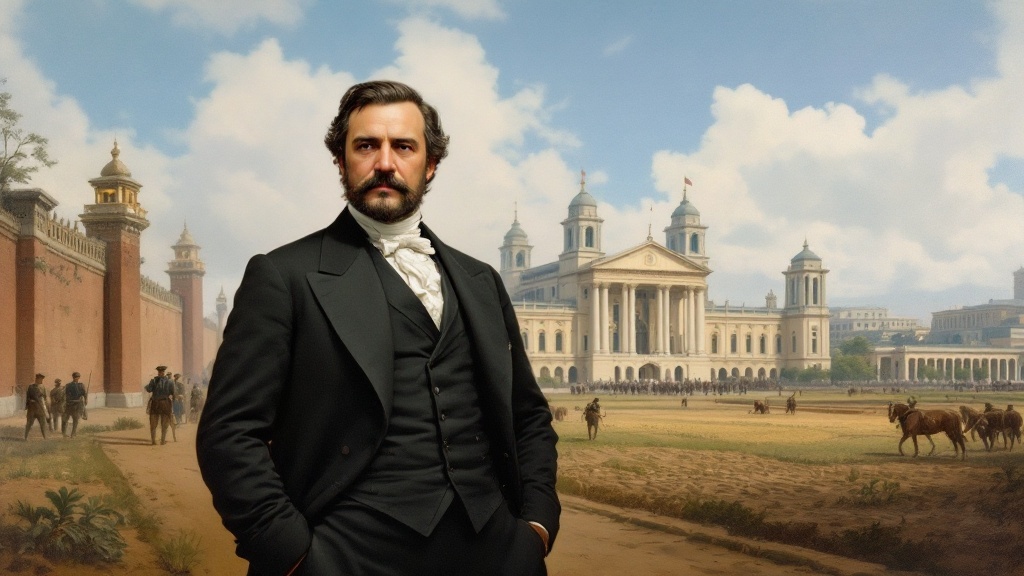
The rule of Dr. Francia
How long did Dr. Francia rule? From 1814 to 1840 - twenty-six years. His style of government was authoritarian, yet he made an enormous contribution to the formation of the Paraguayan nation.
What reforms did Dr. Francia carry out?
- He reinstated the ban on exporting gold and silver from the country.
- He introduced an 8 percent customs duty on all imported goods.
- He created a battalion of grenadiers to defend the country's independence.
- He reserved government posts for Paraguay's local patriciate - its highest social class.
The rule of Dr. Carlos Antonio López
Carlos Antonio López was the first constitutional president of the Republic of Paraguay, serving from 1844 to 1854.
After his term ended, he was re-elected twice:
- for three years (1854-1857);
- for ten years (1857-1867), though he was unable to complete this term, dying on 10 September 1862.
The main achievements of his rule
- Construction of the first section of the National Railway.
- Creation of the National Fleet.
- Opening of the foundries at Ybycuí.
- Development of a military arsenal.
- Growth in production and trade.
- Trade agreements signed with France, the United States and Britain.
- Creation of Paraguay's national anthem.
- Agricultural reform.
- Granting of citizenship to indigenous peoples in 1848 (though their lands and property passed into state ownership).
- Founding of the newspaper El Paraguayo Independiente.
- A complete reorganization of the system of government, backed by an increased budget.
- Opening of printing houses.
- A revival of the country's social life.
- Strengthening of Paraguay's borders and international recognition of its independence.
The War of the Triple Alliance (1864-1870)
Dates: 1864-1870.
Combatants: Paraguay against Brazil, Argentina and Uruguay.
The war began in December 1864 as an armed conflict between Paraguay and Brazil. In May 1865 Argentina and Uruguay joined Brazil, forming the Triple Alliance.
Causes of the conflict
- Brazil interfered in Uruguay's internal affairs and invaded its territory.
- The Uruguayan government requested military assistance from Paraguay.
- Paraguay's president, General Francisco Solano López (1826-1870), resolved to intervene.
President Francisco Solano López feared that Brazil's military invasion of Uruguay could lead to that country's outright occupation. This would upset the balance of power in the Río de la Plata region and threaten Paraguay's independence. López therefore came out firmly against Brazilian intervention. When his position was ignored, he declared war on Brazil. At that point Paraguay and Uruguay were allies against a common enemy - the Brazilian Empire, ruled by Emperor Pedro II.
Consequences of the war
- Paraguay lost two-thirds of its population. Before the war it numbered 500,000 people; between 350,000 and 360,000 died, most of them men. According to the 1870 census, only 140,000 people remained, the majority of them women, children and the elderly.
- The Brazilian Empire expanded significantly. It gained all the territories disputed in the conflict and strengthened its regional influence, particularly in Uruguay. Although its sway over South America gradually waned, Brazil remained the continent's largest economic power.
- Argentina annexed disputed Paraguayan territory. The conflict gave rise to the Argentine province of Formosa. Several Paraguayan governments tried to recover these lands, but without success.
- Political change in Uruguay. The Colorado Party, backed by Brazil, retained power and reshaped the country's political order. Uruguay moved definitively out of Paraguay's political orbit.
- Paraguay was plunged into deep crisis. An economic and demographic catastrophe left the country in decline.
- A shift to liberal government. After the war Paraguay's government adopted a liberal course in the hope of rebuilding the nation. Yet Paraguay never regained its former development or influence.
The Chaco War (1932-1935)
The Chaco War was an armed conflict between Paraguay and Bolivia that lasted from 9 September 1932 to 14 June 1935. Both countries fought for control of the Chaco Boreal, and it became one of the most significant military conflicts in twentieth-century South America.
Over three years of fighting, Bolivia mobilized 250,000 soldiers and Paraguay 150,000. The fighting killed 60,000 Bolivians and 30,000 Paraguayans, with many more wounded, maimed or missing. Soldiers endured brutal conditions - shortages of water, poor food and disease - which drove the death toll higher. Both countries poured vast resources into the war, undermining their economies. Paraguay captured a substantial quantity of weapons and equipment from the Bolivians and, after the war, sold part of this arsenal to Spain (Decree 8406 of 15 January 1937).
A truce was signed on 14 June 1935, but a final settlement was not reached until 1938.
Causes of the war
- Undefined borders. On gaining independence, Paraguay and Bolivia inherited colonial-era border disputes. Four boundary treaties (1879-1907) were never definitively ratified, and the disputes persisted.
- Bolivia's drive for access to the Atlantic. Having lost the War of the Pacific (1879-1884), Bolivia had no access to the Pacific Ocean. The Chaco Boreal became strategically vital, as it offered a route to the Atlantic via the Paraguay River.
- The fight over oil fields. The Chaco region was believed to hold oil. The American company Standard Oil was already developing fields in Bolivia; unable to build a pipeline through Argentina, it saw the Chaco Boreal as an alternative route.
- Argentine involvement. After the War of the Triple Alliance (1865-1870), Paraguay had lost vast territories. In 1879 Argentina attempted to annex part of the Chaco Boreal, but an arbitration ruling by U.S. President Rutherford Hayes recognized the region as Paraguayan. This made it impossible for Paraguay to accept Bolivia's claims to the Chaco Boreal.
Consequences of the war
- On 9 July 1938, under pressure from the United States, Paraguay relinquished 110,000 km² of the territory it had captured.
- The final peace treaty was signed in Buenos Aires on 21 July 1938.
- The Chaco was divided: three-quarters remained with Paraguay, and one-quarter passed to Bolivia, including a stretch of the Paraguay River bank known as the Dionisio Foianini Triangle.
- The negotiations were mediated by the Argentine diplomat Carlos Saavedra Lamas, who received the Nobel Peace Prize in 1936 for his role in resolving the conflict.
The 1938 peace treaty and the final border settlement
On 21 July 1938 the "Treaty of Peace, Friendship and Boundaries" between Bolivia and Paraguay was signed in Buenos Aires. Under it, Paraguay received roughly 75 percent of the disputed territory. Bolivia retained the remaining 25 percent, including access to the Paraguay River.
On 27 April 2009, seventy-four years after the war ended, Presidents Evo Morales of Bolivia and Fernando Lugo of Paraguay signed the definitive agreement on the territorial borders of the Chaco Boreal. The ceremony was held in the presence of Argentine President Cristina Fernández de Kirchner, after the foreign ministers of both countries approved the act implementing and enforcing the 1938 treaty.
The dictatorship of Alfredo Stroessner (1954-1989)
The military dictatorship of Alfredo Stroessner, known as the "Stronato" or "Stronismo," lasted 34 years and 172 days - from 15 August 1954 to 3 February 1989.
Throughout this period Paraguay was ruled by Army General Alfredo Stroessner, making his regime one of the longest-running dictatorships in twentieth-century Latin America.
After Paraguay's second civil war of 1947, the regime of Higinio Morínigo was overthrown. President Juan Natalicio González held office only briefly before being deposed, after which power changed hands every few months. In 1949 Federico Chávez became president; within three weeks he declared a state of emergency to crush his political opponents.
Two decades of political instability wrecked Paraguay's economy
- National income and living standards fell sharply.
- The central bank issued unjustified loans to those close to power, fueling inflation and a black market.
- An economic crisis in Argentina made matters worse.
By 1953, the 73-year-old Chávez had lost the support of both the army and the political elite.
The 1954 coup d'état
Chávez decided to run for another term, disappointing younger politicians and the military. The army was incensed by cuts to the defense budget in favor of the National Police. Epifanio Méndez Fleitas, a former director of the central bank, joined General Alfredo Stroessner in a plot against Chávez. On 4 May 1954, Stroessner ordered the army into the streets, triggering an armed coup. Clashes with the police left around 50 people dead.
After the coup, Stroessner quickly consolidated his power, and his supporters took key government posts. In June 1954 the divided Colorado Party nominated him as its presidential candidate.
Stroessner came to power through repression, intimidation and death squads. These methods allowed him to hold power for 34 years, exercising unlimited control over the state.
Interior Minister Edgar Ynsfrán actively persecuted, terrorized and even killed the relatives of opposition figures. On taking power, Stroessner declared a state of emergency that gave him the right to suspend constitutional freedoms. Anyone could be arrested and held indefinitely without trial. Public assemblies and protests were banned. The state of emergency was renewed every 90 days until 1987 (with a brief exception in 1959). In effect, Paraguay was under martial law for almost the entire Stroessner era.
The death of Felipe Molas López and the withdrawal of Juan Natalicio González from politics removed two influential opponents of the regime. A military coup in Argentina in September 1955 toppled President Juan Domingo Perón, a potential ally of Stroessner's opponents. Perón fled to Asunción, but Argentina's new military junta forced him to leave for Panama.
In December 1955 Epifanio Méndez Fleitas plotted a coup against Stroessner. In response, Stroessner purged the army and drove Méndez Fleitas into exile in 1956.
At that stage Stroessner did not yet fully control the Colorado Party, which was split among rival factions. Even the army was not entirely loyal to his regime.
Economic troubles and protests
- The economy deteriorated sharply. Inflation rose. Businessmen resented restrictions on credit. The army protested cuts to the defense budget.
- In 1958 a general strike broke out as workers demanded higher wages.
- Argentina, unhappy with Stroessner's ties to Perón, cancelled its trade agreement with Paraguay, deepening the economic crisis.
Guerrilla war (late 1950s-1960s)
The 1958 presidential election was rigged, and Stroessner was "re-elected" to a second term.
Opposition groups turned to armed struggle
- Liberal and Febrerista movements launched armed attacks.
- Argentina became a haven for rebels, and from 1958 Venezuela sent them aid.
- In 1959 Cuba's new government under Fidel Castro began backing Paraguay's "United National Front."
Yet Paraguay's peasantry largely supported Stroessner
- Bands of "py nandi" ("the barefoot ones" in Guaraní), loyal to the Colorado Party, brutally dealt with captured rebels.
- Guerrillas were held in concentration-style camps in the jungle.
- The army and police suppressed strikes, crushed the trade unions and arrested their leaders.
The 1959 "liberalization" and the tightening of Stroessner's grip
In April 1959, under pressure from the military and the Colorado Party, Stroessner temporarily eased the regime:
- the state of emergency was lifted;
- exiled opposition figures were permitted to return;
- press censorship was abolished;
- political prisoners were released;
- a new constitution was promised to replace the authoritarian charter of 1940.
But barely two months into this "democratic spring," the country descended into chaos:
- in May 1959 student protests broke out in Asunción, sparked by a rise in transport fares;
- the police used force, injuring around 100 people;
- the National Congress demanded the resignation of Interior Minister Edgar Ynsfrán.
Stroessner responded harshly, reinstating the state of emergency and dissolving parliament. The entire opposition boycotted the 1960 elections.
Building a "multiparty dictatorship"
After the 1960 elections, guerrilla movements grew more active. Yet Stroessner's regime remained stable for several reasons:
- U.S. military aid helped it develop counterinsurgency methods;
- repeated purges of the Colorado Party eliminated every internal opposition faction;
- economic policy attracted investment and reduced inflation;
- military coups in Brazil (1964) and Argentina (1966) created favorable conditions for the dictatorship to continue.
Over time the opposition began to weaken. After years of failure and repression, many groups started seeking compromise. A faction of the Liberal Party returned to Paraguay and was legalized as the Liberal Radical Party (PLR). In the 1963 elections Stroessner allotted it 20 of the 60 seats in parliament. In 1964 the Febreristas, no longer a threat to the regime, were legalized. The Christian Democratic Party (PDC) renounced armed struggle. The Paraguayan Communist Party (PCP) remained the most militant, but Stroessner persecuted its members and their families relentlessly.
With U.S. backing, as part of the Cold War, the regime destroyed Paraguay's communist movement.
The removal of Edgar Ynsfrán and the consolidation of Stroessner's power
Interior Minister Edgar Ynsfrán was a central figure in the repressive apparatus. Yet he opposed the "liberalization" and Stroessner's ambition for a lifelong presidency.
In May 1966 a police corruption scandal gave Stroessner the pretext to dismiss Ynsfrán, which he did in November 1966.
In August 1967, elections were held for a Constituent Assembly, after which:
- a bicameral parliament was established;
- Stroessner gained the right to two additional five-year presidential terms.
The consolidation of absolute power
In the 1968 and 1973 elections, opposition parties were allowed to win a handful of seats in parliament.
In 1977 new elections were held for a Constituent Assembly, after which:
- the limit on presidential terms was abolished;
- Stroessner gained the ability to be re-elected indefinitely;
- in the 1978 elections he "won" once again.
The rise of the opposition (1970s-1980s)
Although Stroessner skillfully balanced the army against the Colorado Party, his grip on the country gradually loosened.
In November 1974 the police arrested seven guerrillas at a farm near Asunción. Interrogations revealed that they had been planning to assassinate Stroessner. The plotters possessed information that could only have come from a senior member of the Colorado Party. Stroessner immediately arrested and interrogated more than 1,000 officials and party functionaries. Regime agents traveled to Argentina and Brazil to abduct suspects among the exiled Colorado members. A mass purge of the party followed.
Although the system held, the regime was shaken. A fresh wave of mass arrests came during the "Bloody Easter" of 1976.
Conflict with the Catholic Church
From the late 1960s, leaders of the Catholic Church began to openly criticize the dictatorship for:
- extending Stroessner's terms in office;
- the mistreatment of political prisoners.
In response, the regime:
- shut down Catholic newspapers and magazines;
- expelled foreign priests from the country;
- persecuted church organizations that helped the poor.
Despite the repression, the Church continued to publish the opposition newspaper Sendero.
International condemnation of the regime
During the 1970s the international community grew increasingly critical of Stroessner over human rights abuses.
In 1978 the Inter-American Commission on Human Rights (OAS) passed a resolution demanding improvements in Paraguay's human rights situation.
In 1980 the OAS General Assembly, meeting in La Paz, Bolivia, formally condemned the regime, calling its prisons and torture, disappearances and executions of political prisoners "an affront to the conscience of the entire continent."
International organizations reported that the military had killed 30 peasants and arrested another 300 after protests against the seizure of their land by officials.
The emergence of a serious political opposition
In 1977 the member of parliament Domingo Laíno (PLR) founded the Authentic Liberal Radical Party (PLRA).
Laíno accused the regime of:
- corruption;
- ties to drug traffickers;
- human rights violations;
- unfair financial arrangements with Brazil over the Itaipú Dam project.
In 1979 Laíno brought several opposition parties together in the National Accord, which became the focal point of opposition to the regime. Amid persecution and torture, he was forced to flee the country in 1982.
The assassination of the dictator Somoza and Stroessner's fears
In 1980 the former Nicaraguan dictator Anastasio Somoza Debayle was assassinated in Asunción. Exiled from his homeland, Somoza had found refuge in Paraguay and had even published a book, Nicaragua Betrayed. His killing showed that even dictators were not safe.
Stroessner saw it as an ominous sign:
- like him, Somoza had built his regime on military power;
- like him, Somoza had kept the opposition divided;
- like him, Somoza had long seemed "unsinkable," yet in the end his regime collapsed.
Paraguay's opposition kept gaining strength, and Stroessner's regime steadily lost control.
Paraguay's economic development and foreign relations under Stroessner
Argentina played an important role in Paraguay's international trade. Paraguay was granted tax-free use of port facilities on Argentina's Atlantic coast, which greatly simplified its exports and imports.
The construction of the Itaipú Dam (1973-1982)
The Itaipú Dam, built on the Paraná River between Paraguay and Brazil, became one of the largest hydroelectric projects in the world.
Construction cost 19 billion U.S. dollars. Paraguay could not contribute financially, but its territory and consent were essential to the project. The electricity generated at Itaipú became a new source of wealth for the country. During the construction period (1973-1982), the economy grew by 8 percent a year - double the pace of the previous decade. Revenue from electricity exports to Brazil rose many times over. Job creation during construction boosted domestic demand and stimulated agricultural growth.
The project also had negative consequences, however. After construction ended in 1982, economic growth slowed, provoking discontent and demands for reform. Many Paraguayans accustomed to steady work were forced to emigrate. By some estimates, up to 60 percent of Paraguayans were living abroad by the 1980s. Brazilian migration into eastern Paraguay reached 300,000-350,000 people, bringing cultural and economic change. In those regions Portuguese became the dominant language, and the Brazilian real circulated alongside the Paraguayan currency.
Moreover, most of the profits from Itaipú went to the elite connected with the regime:
- large landowners faced no agrarian reform;
- control over the trade unions boosted business profits;
- foreign investors received tax breaks;
- foreign creditors profited from Paraguay's large loans;
- the poor, though better off than in the 1960s, saw the gap between rich and poor widen.
FAQ
Who was Doctor Francia?
What started the War of the Triple Alliance?
How many people did Paraguay lose in the Triple Alliance war?
Who won the Chaco War?
How long did Stroessner rule Paraguay?
Who owns the Itaipu dam?
Don’t want to figure this out alone?
We handle the whole process end to end: we check your documents, match a program to your situation and give you honest timelines and costs. Leave your details and a migration expert will get back to you. The first consultation is free.